Avia Logo

Compare Products


Jump to:
Categories
Solutions
Description
Compatibility Level
Clients
Use cases
EHR integrations
Client types
Differentiators
Keywords
Media
Company details
Jump to:
Categories
Solutions
Description
Compatibility Level
Clients
Use cases
EHR integrations
Client types
Differentiators
Keywords
Media
Company details

Categories

Solutions

Description

Product Description:
Corrie is an evidenced-based digital health program that has been evaluated in the Myocardial Infarction, COmbined-device, Recovery Enhancement MiCORE Study (ClinicalTrials.gov Identifier: NCT03760796) at 4 hospitals and was shown to reduce risk of 30-day readmission, improve patient experience, and create cost-savings. Corrie is a prescription strength virtual care program that consists of a smartphone application paired with a smartwatch and bluetooth blood pressure cuff. Key features of Corrie include 1) tracking and reminders for cardiac medications; 2) monitoring BP with an Food and Drug Administration–approved wireless BP cuff; 3) promoting exercise, physical activity, step tracking, via a smartwatch 4) providing peer-reviewed educational videos and articles on diet, medications, and how to prevent CVD/hypertension/dyslipidemia/glucose intolerance through lifestyle modification; 5) reviewing patient reported data through a check-up feature that allows patients to send health summary reports of physical activity and vitals to clinicians; and 6) connecting with providers and addressing social determinants of health services to optimize guideline-directed evidence-based care. In the era of COVID-19 and beyond the Corrie program is a technology-enhanced patient experience that provides the fundamental care components, data collection, and support for optimal cardiac recovery.
About Corrie Health:
Helping to solve one of the largest problems facing global healthcare, we are fortunate to have a Johns Hopkins team that has been intensively working in digital health technology and leading the world in its development, evaluation, and integration with healthcare delivery. The Corrie Health® Platform is the culmination of 4 years of cross-university teamwork and research at Johns Hopkins to improve evidenced-based care at Johns Hopkins and across the country. Corrie (“Cor” is Latin for heart) was created by an interdisciplinary team of Johns Hopkins cardiologists, internists, nurses, engineers, Armstrong patient safety and quality improvement leaders, and behavioral health specialists, in partnership with Apple designers and patients to improve cardiovascular prevention. Corrie’s intuitive user interface was built in close collaboration with engineers and designers at Apple to empower patients in self-management, and is now available on Android as well. At its core, the Corrie Health® Digital Platform is a smartphone application driving self-management of medications, vitals, activity, and care coordination connected to cooperative sensors including a smartwatch and wireless blood pressure cuff. The Corrie Cloud securely stores data metrics and vitals from the app to make them accessible within the upcoming Corrie Portal where real-time data analysis is performed to detect digital biomarkers and activate external actions via the Corrie Decision Engine. This will trigger near real-time alerts on Corrie Care for providers, care companions, and pharmacists so they can respond in a timely fashion to risk signals detected from changes in the patient’s clinical status. Corrie Health® is the intersection of enhanced patient engagement, data analytics targeting digital biomarkers, and remote monitoring working together to reduce hospital readmissions and promote personalized, cost-effective care. The Corrie Care app and the Corrie Portal will initially be available as a technology preview and grow in features as we continue to gather feedback. Corrie Health® offers major value to Hospitals by providing a clinically validated digital health platform deployed in the acute care setting. The Corrie Myocardial infarction, COmbined-device, Recovery Enhancement (MiCORE) Study examined whether using the Corrie Health Digital Platform could reduce all-cause, unplanned 30-day hospital readmissions and related healthcare costs for acute myocardial infarction (AMI) patients as compared to a historical comparison group. The study was carried out at two leading academic hospitals, Massachusetts General and Johns Hopkins, and two community hospitals, Reading Health System and Johns Hopkins Bayview Medical Center. Corrie was the intervention in the study that served as a self-management digital health program to support guideline-directed care including: 1) medication adherence, 2) vitals monitoring, 3) peer-reviewed education, 4) physical activity, 5) follow-up appointment tracking, and 6) connection with clinicians. From October 1, 2016 to April 14, 2019, 200 English-speaking adults diagnosed with Type I AMI who owned a smartphone were enrolled across four hospitals in the United States. Patients received Corrie as early as possible in their hospitalization and were encouraged to use it during the hospitalization through 30 days post-hospital discharge. The historical comparison group consisted of 864 adults who were admitted between October 2015-2016 with STEMI or NSTEMI from these study hospitals. The final results are under review but showed: ● Major reduction in risk of 30-day all cause readmission compared to the historical control group ● Significant cost savings per patient compared to standard of care alone for a hospital and increased quality of life years. [Based on the assumption that Corrie costs $3,000 per patient. Cost savings is per hospital based on savings from readmission reduction] ● Majority of Corrie users felt confident managing medications, follow-up appointments, and home care at 30 days
Product Description:

Coordinista is mobile-first platform built for mobile and hybrid primary and post-acute care teams managing high-touch populations. 

Nurse designed, Coordinista shifts data and workflows to the point of care, helping teams improve outcomes, stay compliant, and strengthen their bottom line.

Lightweight and EHR-agnostic, Coordinista empowers field teams to self-manage schedules and reduce administrative burden and drive time while giving organizations full transparency and audit-ready reporting. Its robust field-based self-management system can also be used as a central command center, flexing as needed across different care delivery models even within the same organization.

For Primary Care: Coordinista ensures accurate condition capture with embedded coding tools at the point of care, safeguarding risk adjustment integrity and aligning reimbursement with true patient acuity. It also streamlines mobile phlebotomy, eliminating manual faxes and driving lab order data directly into workflows.

For Care Management: Coordinista streamlines operations for your team and accelerates transitions of care continuity and responsiveness, like enabling medication reconciliation in the home within 48 hours of discharge, improving outcomes and boosting downstream patient satisfaction and CCM engagement while reducing costly readmissions and ER visits.

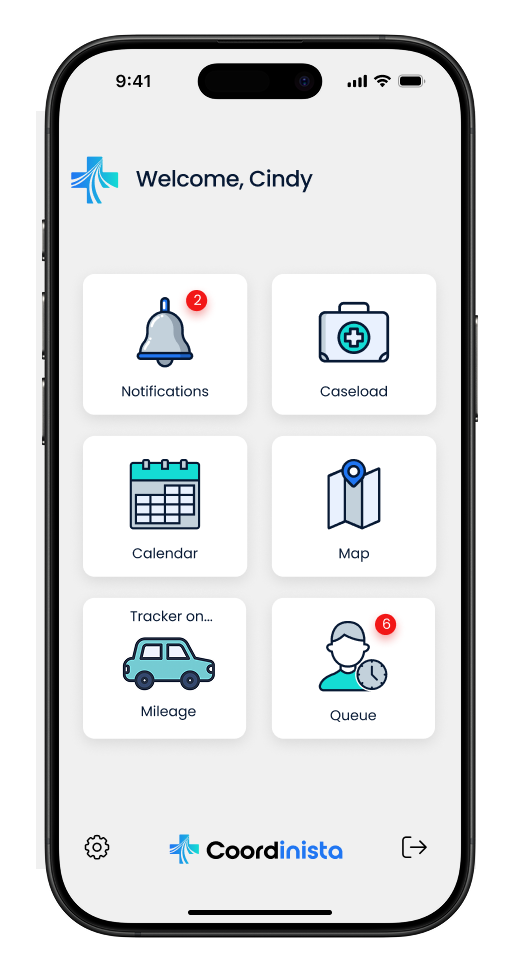
With customizable workflows, real-time audit safeguards, and seamless interoperability, Coordinista supports multiple lines of business while reducing waste. Every encounter, whether in-person, telephonic, or administrative, is tracked by time, duration, and geo-location, with data instantly available on the administrative dashboard. A built-in mileage tracker makes reporting effortless for clinicians and administrators alike.

Coordinista helps care teams deliver higher-quality, compliant, and efficient care anytime, anywhere.

About Coordinista:

Coordinista is a first-of-its-kind, mobile-first platform built for mobile and hybrid primary and post-acute care teams managing high-touch populations. Nurse designed, it brings data and workflows to the point of care, helping teams improve outcomes, stay compliant, and strengthen their bottom line.

Compatibility level

Select which hospital or health system you work at and see a personalized compatibility level.

Clients

Select which hospital or health system you work at and see the client list

Use Cases

Description:

None provided

Pediatric use cases:

None provided

Users:

None provided

Description:

Care Management Teams Serving High-acuity Populations

Coordinista streamlines CM and TOC operations and ensures accountability and continuity. Teams can complete critical tasks—like in-home medication reconciliations within 48 hours of discharge, leading to reduced readmissions and ER visits, and boosting patient engagement. The result: stronger quality scores, higher satisfaction, and better outcomes for both patients and organizations.


Mobile Primary Care Teams (ISNP & DSNP Populations)

Coordinista equips mobile and hybrid primary care teams to deliver seamless primary care, care management, and transitions of care across wide territories. By unifying scheduling, documentation, and communication, providers can optimize resources, ensure continuity between teams, and maintain full transparency while serving complex populations.


HCC Recapture Programs

Coordinista helps teams maximize accuracy and efficiency in HCC recapture. In one case, a mobile provider team completed 1,400+ chronic disease assessments across 40+ facilities in just 23 days—analyzing 1,600+ historical ICD-10 codes and increasing an ISNP plan’s RAF score by 16%. At the point of care, embedded coding tools ensured actionable, accurate condition capture, protecting risk-adjustment integrity and aligning reimbursement with actual patient acuity.


Mobile Phlebotomy

Coordinista modernizes mobile phlebotomy by eliminating manual fax and email workflows. Lab orders flow directly to the point of care, improving turn-around times, accuracy, and productivity.

Pediatric use cases:

Supports care management associated with Medicaid and pediatric populations. 

Users:

Coordinista has delplyed with mobile providers across MI, WV, OH, will be deploying soon in IN and MD. Coordinista provides value for each level of stakeholders.

Clinicians in the Field


What they need: Flexibility, efficiency, and less administrative burden so they can focus on patients.

How Coordinista helps:

  • Mobile-first tools making it fast and easy to self-manage caseloads and schedules.
  • Point-of-care documentation with embedded coding tools to capture real patient acuity.
  • Integrated workflows for labs, phlebotomy, and transitions of care—no more juggling faxes or duplicate entry.
  • Built-in mileage tracker and time capture to simplify reporting.

Impact: More time with patients, less administrative burden, and confidence that nothing slips through the cracks.


Supervisors / Care Team Managers

What they need: Visibility, accountability, and seamless coordination across teams.

How Coordinista helps:

  • Real-time transparency into schedules, caseloads, and field activity.
  • Dashboards that show productivity, engagement, and compliance at a glance.
  • Ability to flex between self-managed and centrally scheduled models—even within the same organization.
  • Customizable workflows and alerts to ensure deadlines (TOC, CCM, quality tasks) are consistently met.

Impact: Stronger team performance, faster responsiveness to patient needs, and improved quality scores.


Administrators / Operations Leaders

What they need: Compliance, financial integrity, and efficient use of resources.

How Coordinista helps:

  • Audit-ready reporting of all encounters (time, duration, geo-location) in real time.
  • Accurate condition capture to protect risk-adjustment integrity and align reimbursement with true acuity.
  • Seamless interoperability with any EHR or data system to reduce manual work and improve security.
  • Operational insights that identify waste and highlight opportunities for optimization.
  • Improved outcomes, quality, and compliance, resulting in more savings, increased revenue, and better margins. 

Impact: Lower costs, stronger compliance, improved reimbursement, and data-driven decisions to scale efficiently.

EHR Integrations

Integrations:

None provided

EMR Integration & Relevant Hardware:

None provided

EMRs Supported:

None provided

Hardware Compatibility:

None provided

Integrations:

Acute care EMR, Ambulatory EMR, Ancillary EMR, Pop health platform, Home health, ADT

EMR Integration & Relevant Hardware:

Use case dependent

EMRs Supported:

Athenahealth

Hardware Compatibility:

Desktop, Mobile / Tablet (native app)

Client Types

None provided

Differentiators

Differentiators vs EHR Functionality:

None provided

Differentiators vs Competitors:

None provided

Differentiators vs EHR Functionality:

Coordinista's interoperability technology and capabilities are amongst the best in the word. Coordinista can integrate with any standard or format, whether HL7, FHIR, CCDA, or others for secure and seamless bi-directional data flow. 

Differentiators vs Competitors:

Coordinista's advantage is empowering point-of-care decisions-making and deployment strategy for best outcomes. 

Operations

  • Centralized Dispatch Systems: Centralized deployment, costly schedulers & overhead
  • Decentralized Dispatch Models: High manual administrative burden, lacks field transparency and insight

Coordinista: Decentralized & centralized deployment, schedulers not required, transparent, streamlines admin, reduces overhead

Data

  • Centralized Dispatch Systems: Scheduling related data
  • Decentralized Dispatch Models: Siloed data, limited analytics

Coordinista: Real-time actionable diagnosis, lab orders, patient risk level, hospitalizations, services, mileage, and patient data and analytics

Technology

  • Centralized Dispatch Systems: Single system, complex for users, scheduling capabilities and patient notification
  • Decentralized Dispatch Models: Multiple, clunky, disconnected tools, not healthcare-first

Coordinista: Clinician friendly, end-to-end operations, healthcare dedicated, mobile-native, HIPAA, Integration ready for any ecosystem

Value

  • Centralized Dispatch Systems: Scheduling only, often disliked by clinicians and patients
  • Decentralized Dispatch Models: Inefficient, missed compliance, higher patient admissions

Coordinista: Efficient, flexible for dual deployment ops, resource utilization insight for best patient outcomes

Keywords

Images

No images provided

1 of 1

edit-media
home-page.png

Videos

No videos provided

No videos provided

Downloads

No content provided

media thumbnail
Case Study_ Avail Health WV.pdf

Alternatives

Company Details

Need help narrowing down products?

Add more criteria to see your compatibility level for every vendor. It only takes a few minutes, just create a free account to get started.
back to top