Avia Logo

Compare Products


Jump to:
Categories
Solutions
Description
Compatibility Level
Clients
Use cases
EHR integrations
Client types
Differentiators
Keywords
Media
Company details
Jump to:
Categories
Solutions
Description
Compatibility Level
Clients
Use cases
EHR integrations
Client types
Differentiators
Keywords
Media
Company details
Lena
Lena

0 review

Lyft Smart on FHIR
Lyft Smart on FHIR

0 review

Categories

Solutions

Description

Product Description:

Lena is a Personal Health Assistant for concierge care navigation through SMS-text. Lena is a Conversational AI bot that provides immediate and 24/7 assistance to answer patient questions and perform administrative tasks.


The Lena bot can loop in real human Lena Advocates to provide additional comprehensive assistance when patients need additional guidance. The result is an end-to-end and comprehensive navigation support for patients to ensure appropriate and timely access to health resources.

About Lena Health:

Lena is a Personal Health Assistant that handles the health tasks that often fall on seniors to do themselves. Patients can text their Lena Health Assistant to schedule their appointment, find a specialist, answer coverage questions, find transportation, schedule their prescription refills, and so much more.


Product Description:

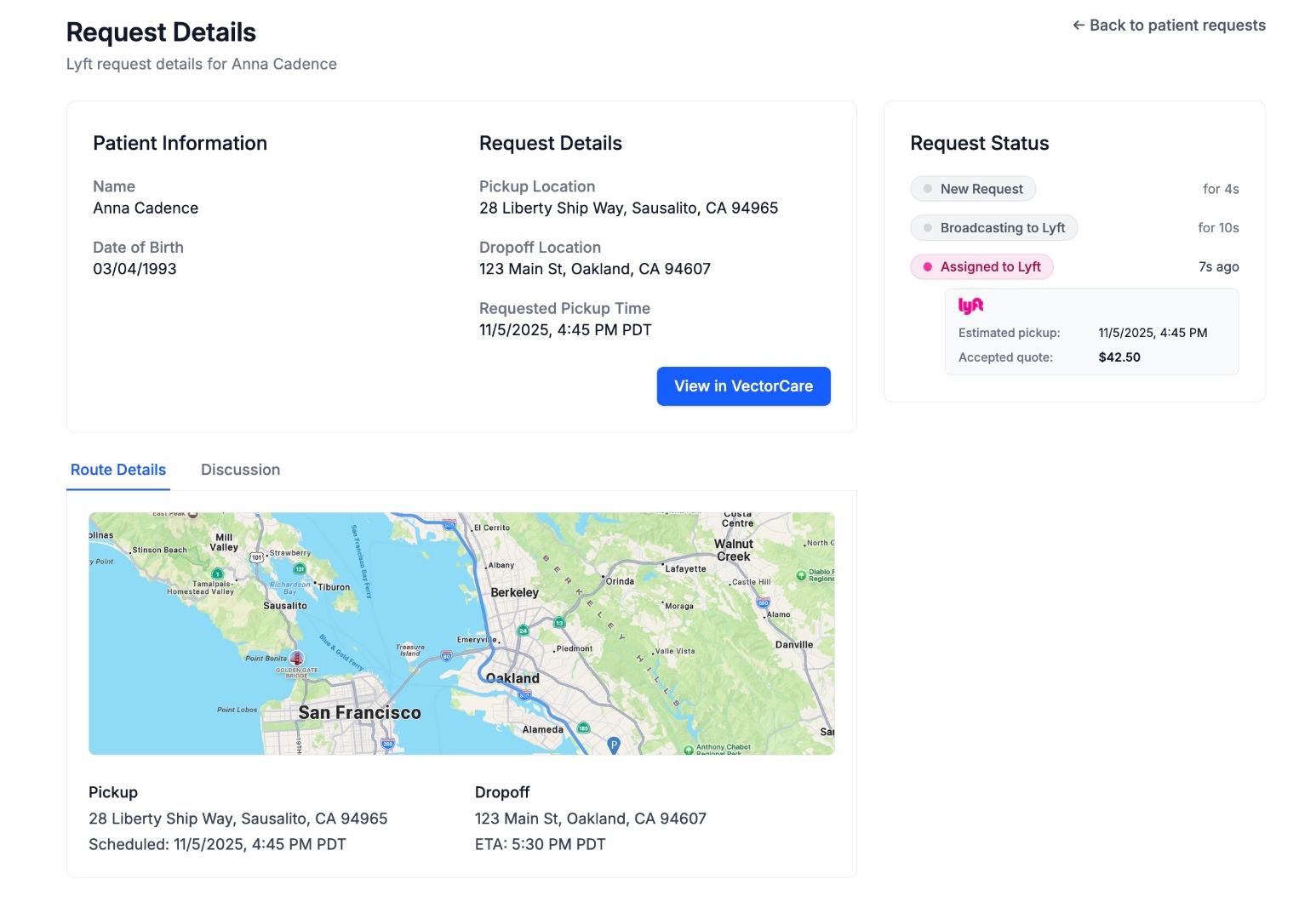
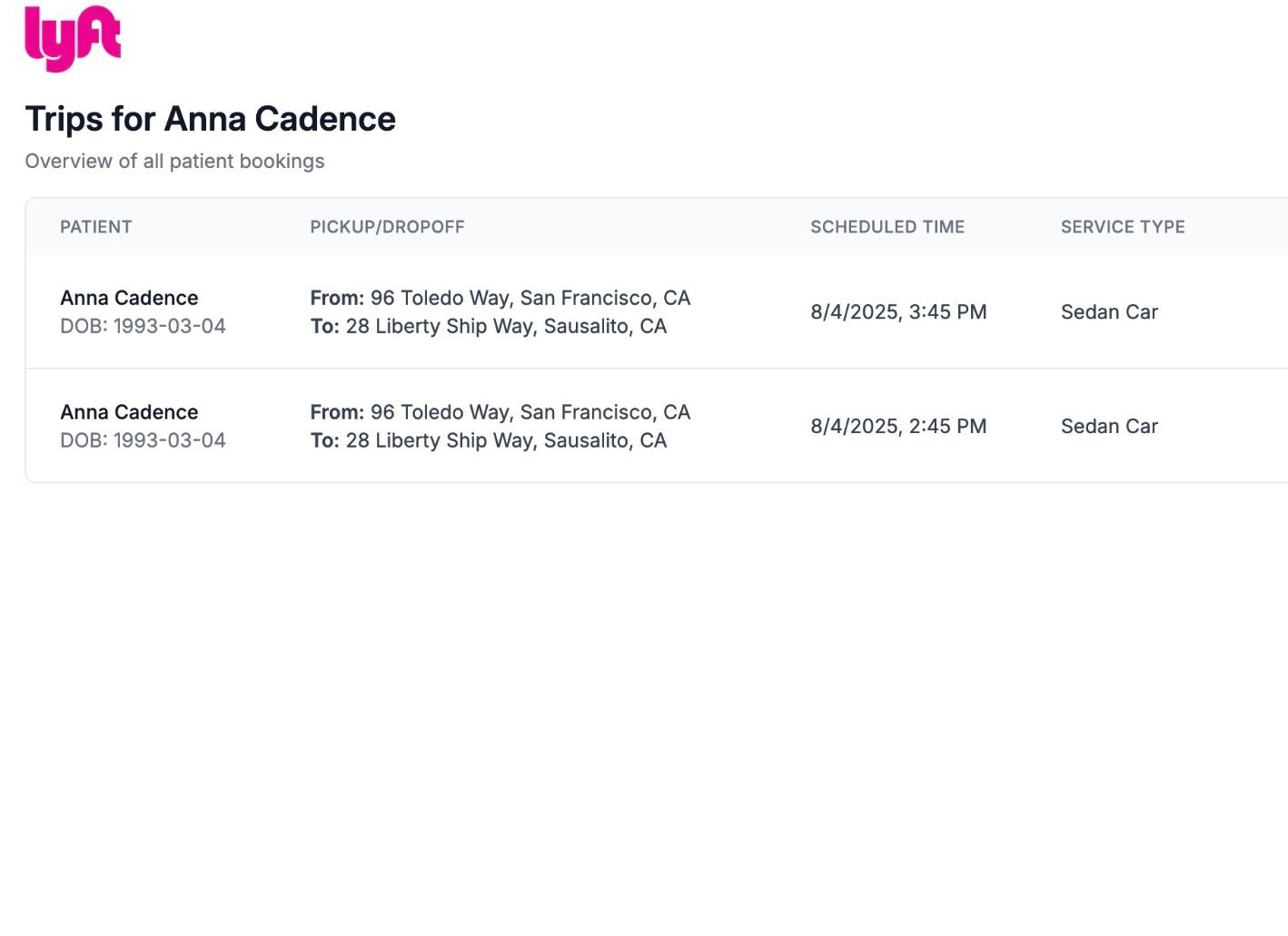
The Lyft Smart on FHIR App allows care teams to schedule directly from within the EHR, get real-time updates, live map, and message with drivers. Great for discharges or outpatient services. 

About VectorCare Inc.:

Accelerating the Future of Patient Logistics. Build and deploy workflow in minutes to any EHR.

Compatibility level

Select which hospital or health system you work at and see a personalized compatibility level.

Clients

Select which hospital or health system you work at and see the client list

Use Cases

Description:

None provided

Pediatric use cases:

None provided

Users:

None provided

Description:

🚑 VectorCare + Lyft Smart on FHIR: Hospital Use Cases

1. Faster, More Efficient Discharge Planning

Problem: Discharge delays occur because patients lack a ride home or transportation is arranged manually via calls and faxes.

Value of the App:

  • Case managers can instantly request a Lyft trip directly from the EHR using FHIR data (patient demographics, pick-up location, discharge time).

  • Eliminates phone calls, manual forms, and coordination delays.

  • Reduces discharge bottlenecks that hold beds for hours or days.

Outcome: Faster throughput, higher bed availability, and reduced cost per inpatient stay.

2. Automated Trip Details Through FHIR Context

Problem: Transportation details are often typed manually, leading to errors in patient address, mobility level, or scheduling.

Value of the App:

  • Auto-pulls demographics, mobility, preferred address, appointment time, and clinical flags from the EHR.

  • Reduces errors and ensures the right vehicle type (Lyft standard, XL, wheelchair-accessible where available).

Outcome: Time savings for staff and safer, more appropriate ride assignment.

3. Reducing ED Boarding for Non-Emergent Patients

Problem: Many ED patients who are medically cleared cannot leave due to lack of transportation.

Value of the App:

  • ED nurses/social workers can request an immediate Lyft ride directly from the chart.

  • Patient can be moved out of ED within minutes, not hours.

Outcome: Higher ED throughput, improved door-to-doc times, and reduced LWBS rates.

4. Closing Gaps in Care for Outpatient / Ambulatory Visits

Problem: No-show appointments increase when patients rely on unreliable or costly transportation.

Value of the App:

  • Automatically schedules a Lyft ride for follow-up visits, labs, imaging, or primary care appointments.

  • Uses EHR-integrated data to align arrival time with appointment time.

Outcome: Lower no-shows, higher adherence to care plans, improved clinical outcomes.

5. Supporting Social Determinants of Health (SDOH) Programs

Problem: Under-resourced patients frequently miss visits due to transportation challenges.

Value of the App:

  • Social workers can instantly schedule rides using the patient’s chart info.

  • Hospitals can track ride utilization and outcomes for SDOH reporting.

Outcome: Better equity, better compliance, and improved community outcomes.

6. Streamlined Transport for Imaging & Procedural Workflows

Problem: Patients often must travel between hospital campuses or buildings (e.g., imaging, infusion, same-day procedures).

Value of the App:

  • Integrated FHIR location data makes inter-campus transfers seamless.

  • Staff schedule rides with one click while keeping the patient workflow aligned in the EHR.

Outcome: Reduced intra-facility delays and fewer missed slots in radiology or procedural departments.

7. Safe Transport for Patients Discharging to Non-Medical Facilities

  • (RSNF, shelters, temporary housing, recovery programs)

  • Problem: Hospitals often struggle coordinating rides for vulnerable patients, requiring multiple phone calls.

Value of the App:

  • Pre-populate destination facilities from templates.

  • Document the ride in the EHR automatically for risk and compliance.

Outcome: Faster placement and improved support for high-risk populations.

8. Automated Documentation & Audit Trail

Problem: Hospitals must document how patients were transported and maintain compliance with payer and audit requirements.

Value of the App:

  • Ride events and costs write back into the EHR via FHIR.

  • No need to manually chart the patient’s transport.

Outcome: Cleaner audits, reduced administrative burden, and accurate encounter documentation.

9. Integration With Hospital Billing / Cost Centers

Problem: Transportation costs are manually tracked or lost.

Value of the App:

  • Allocate transportation spending to specific cost centers or service lines.

  • Nurses and case managers do not need to worry about managing invoices.

Outcome: Financial transparency and better budgeting.

10. Support for Hospital-at-Home or Remote Monitoring Programs

Problem: Delivering equipment or transporting patients for at-home care requires coordination.

Value of the App:

  • Schedule Lyft rides to deliver equipment or transport patients for temporary in-home care transitions.

  • Works seamlessly with EHR-based care pathways.

Outcome: Supports expansion of home-based care models.

Pediatric use cases:

None provided

Users:

Case managers, administrators, home health teams, care teams, Nurses, and patient logistics coordinators.

EHR Integrations

Integrations:

None provided

EMR Integration & Relevant Hardware:

None provided

EMRs Supported:

Epic

Hardware Compatibility:

None provided

Integrations:

Acute care EMR, Ambulatory EMR, Ancillary EMR, ERP system, Patient portal, Pop health platform, Home health, Behavioral health, Community based organizations, ADT, Access +/or revenue cycle, Credentialing, Website / public online sources, Other

EMR Integration & Relevant Hardware:

Not applicable

EMRs Supported:

Epic, Cerner, Meditech, Allscripts, NextGen, athena, GE, eClinicalWorks, McKesson, Other, Allscripts/Eclipsys, Athenahealth, Azalea Health/Prognosis, CPSI, Evident, Healthland, MEDHOST, MedWorx, QuadraMed, Self-developed, Would prefer not to disclose, Point Click Care

Hardware Compatibility:

Not applicable

Client Types

Differentiators

Differentiators vs EHR Functionality:

None provided

Differentiators vs Competitors:

None provided

Differentiators vs EHR Functionality:

There is no Lyft service for Epic. This is the first of its kind.

Differentiators vs Competitors:

VectorCare – Key Differentiators (vs Mōvi, StatCall, Roundtrip)

1. First SMART on FHIR App for Lyft / Patient Logistics

Fully embedded inside Epic, Cerner, and Allscripts.

Launches directly from the patient chart—no separate login or portal.

Auto-populates all patient + encounter data instantly.

2. True “In-EHR” Workflow (Zero App Switching)

Case managers, ED nurses, and social workers stay inside the EHR.

Eliminates manual data entry, cutting scheduling from ~31 minutes to under 1 minute.

Reduces errors and improves compliance documentation.

3. Full-Service Logistics Platform (Beyond Transport)

Coordinates transport + home health + DME + post-acute support in one workflow.

Competitors largely focus on transport only.

4. No-Code Workflow Builder

Hospitals can design custom discharge or service workflows without IT effort.

Hyper-localize by facility, department, or service line.

5. Unified Vendor Network + Rideshare + NEMT

Lyft/Uber + wheelchair + gurney + ambulance vendors, all in the same platform.

Hospitals are not forced into a single NEMT broker model.

6. Real-Time Tracking & Status Inside the EHR

Live GPS, ETAs, on-scene, ride events, alerts — all charted automatically.

Removes the need for phone calls between case managers and vendors.

7. Faster Deployment, Minimal IT Burden

SMART on FHIR + no-code = rapid implementation across entire systems.

Significantly lower IT requirements than traditional NEMT platforms.

8. Designed for Discharge + Throughput Optimization

Focused on bed turnover, ED throughput, and delayed discharge prevention.

Competitors skew toward outpatient NEMT or recurring transport, not inpatient flow.

9. Single Platform for All Service Requests

Transportation, equipment deliveries, home-health visits, and more.

Hospitals reduce tool sprawl and simplify user training.

10. Automatic Documentation + Audit Trail

All ride and service data is written back into the EHR for compliance.

Avoids chart gaps and payer disputes.

Keywords

Images

No images provided

1 of 3

edit-media
lyft epic.jpeg

Videos

No videos provided

1 of 1

edit-media
Lyft Smart on FHIR powered by VectorCare

Downloads

media thumbnail
Lena Health - Houston Methodist Coordinated Care Case Study 2021.pdf

No content provided

Alternatives

Company Details

Founded in 2019

Need help narrowing down products?

Add more criteria to see your compatibility level for every vendor. It only takes a few minutes, just create a free account to get started.
back to top