Avia Logo

Compare Products


Jump to:
Categories
Solutions
Description
Compatibility Level
Clients
Use cases
EHR integrations
Client types
Awards
Differentiators
Keywords
Media
Company details
Jump to:
Categories
Solutions
Description
Compatibility Level
Clients
Use cases
EHR integrations
Client types
Awards
Differentiators
Keywords
Media
Company details

Categories

Solutions

Description

Product Description:

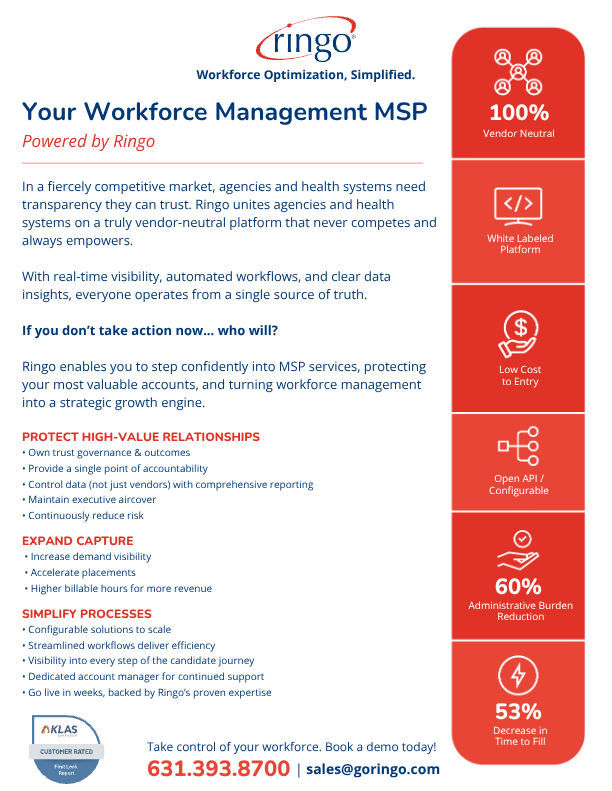
Ringo is a healthcare-specific Managed Service Provider (MSP) and Vendor Management System (VMS) designed to help hospitals and health systems streamline contingent labor operations, improve staffing transparency, and reduce workforce costs. Founded in 2001, Ringo began as a hospital billing solution focused on eliminating administrative complexity. In 2020, the company launched its NextGen VMS—purpose-built for healthcare—to address growing challenges around contract labor management, vendor coordination, credentialing, and workforce compliance.

As a vendor-neutral MSP and VMS, Ringo empowers healthcare organizations with full visibility and control across every stage of the staffing lifecycle. Our platform centralizes job distribution, rate card management, credential tracking, and consolidated invoicing—giving clinical, HR, and finance teams a single source of truth for all workforce data. By eliminating manual processes and automating contract enforcement, Ringo helps reduce overbilling, enhance fill rates, and ensure every placement meets regulatory and credentialing standards.

Ringo supports healthcare facilities nationwide, managing more than $275 million in annual contingent labor spend and delivering measurable operational improvements. In the KLAS 2025 First Look Report, Ringo earned outstanding ratings—including 94.2 overall satisfaction and 100% of customers saying they would buy again—highlighting our ease of use, platform reliability, and high-touch service model.

Why Ringo Stands Out

Purpose-built for healthcare: Designed specifically for the complexities of hospitals, imaging centers, and health systems.

Vendor-neutral MSP model: Ensures transparency, eliminates vendor favoritism, and drives fair competition for higher quality placements.

AI-powered automation: Reduces manual tasks, accelerates time-to-fill, and improves shift coverage reliability.

Real-time workforce analytics: Gives leaders actionable insights on vendor performance, labor spend, credentialing compliance, and staffing trends.

Operational and financial impact: Clients typically achieve 15–20% cost savings, faster onboarding, fewer errors, and stronger vendor accountability.

End-user–focused design: Intuitive workflows built for clinicians, staffing offices, recruiters, and finance teams alike.

Ringo’s mission has always been centered on clarity, transparency, and smarter workforce management. Whether a health system needs a fully managed MSP solution or a powerful vendor management platform to enhance its internal processes, Ringo delivers the tools and expertise to help organizations operate more efficiently and strategically.

About Ringo VMS:

Ringo is a healthcare-focused technology and services partner with roots dating back to 2001, originally built to solve operational challenges inside hospitals. Over the past two decades, we evolved from a billing optimization tool into one of the industry’s most advanced Vendor Management Systems (VMS), launched in 2020 to support modern healthcare workforce management and address the growing complexity of contract labor management across healthcare organizations.

By listening closely to our clients, Ringo launched its NextGen Vendor Management System (VMS) in 2020—purpose-built for healthcare. Our vendor-neutral, AI-powered platform enables hospitals, health systems, and physician groups to optimize their workforce while maintaining full control and visibility over every staffing decision.

Today, Ringo supports healthcare systems nationwide—managing over $275 million in contingent labor spend annually. We provide real-time workforce analytics, credential alerts, and automated invoice accuracy tools that ensure compliance, transparency, and measurable cost savings.

What makes Ringo stand apart is more than technology—it’s partnership. We operate as an extension of your team, providing consultative support, MSP options, and customizable workflows to fit your organization’s goals. From shift optimization and rate enforcement to digital timekeeping and automated job distribution, every feature is designed to drive efficiency, reduce time-to-fill, and improve patient care continuity.

Ringo delivers results:

  • 15–20% average labor savings through automated rate and billing controls
  • Accelerated onboarding via pre-credentialing and compliance automation
  • Workforce visibility dashboards by site, specialty, and vendor
  • Quarterly business reviews with actionable insights and benchmarking

We believe a truly effective healthcare staffing platform is more than software—it’s a strategic ally. That’s why Ringo continues to redefine contingent workforce management through AI-driven innovation, vendor neutrality, and a shared commitment to helping healthcare organizations operate with greater clarity, confidence, and control.

Key Features:

  • Vendor Management System (VMS) built for healthcare
  • Workforce optimization & contingent labor management
  • Credential alerts & compliance automation
  • MSP or in-house program flexibility
  • Invoice accuracy & spend transparency
  • Digital timekeeping & shift optimization
  • Enterprise-level reporting & analytics
  • Vendor-neutral, AI-powered platform
  • $0 startup costs for hospitals and physician groups
  • Much much more!

Discover how Ringo can help your organization streamline operations, reduce costs, and gain full visibility into your workforce.

Workforce Optimization, Simplified.

Milan Boulette, Chief Revenue Officer

Call: 631-629-6242

Email: mboulette@goringo.com

www.goringo.com

Request your complimentary demo today and experience the Ringo difference.

Product Description:

Rhinogram’s proven digital communication strategy provides solutions that empower patients and staff with a complete and compliant digital patient journey.

Optimize care and communication with patients and full care and administrative teams securely and effectively in one HIPAA-compliant platform that elevates care, patient compliance, and profitability. Streamline and liberate clinical and administrative teams across your organization and increase the quality of care your facility provides, all while increasing billable services, and providing better care to patients through better connections.

  • Receive patient-initiated direct SMS/MMS text messages via your existing system phone number.
  • Respond to 6-10 patients via the Rhinogram platform in the time it typically takes to respond to the needs of one patient via phone cal. 
  • Automate and expedite the patient intake process and consent with RhinoForms that patients can complete from their phones with as little as one bar of cellular service, or through an in-office ipad.
  • Automatically send patients payment link to click to pay their bill for faster processing.    
About Rhinogram:

Rhinogram recently recognized by KLAS TOP 20 Emerging Solutions: Improving Patient Experience & Reducing Cost of Care. With Rhinogram healthcare systems optimize their communication and connections with patients and healthcare organizations securely and effectively. Studies show that 83% of patients would prefer to text messages. Rhinogram gives healthcare systems and their patients HIPAA-compliant methods of communication that elevate care, patient compliance, and profitability. Streamline and liberate clinical and administrative teams across your organization, and increase the quality of care your facility provides, all while increasing billable services, and providing better care to patients through better connections.


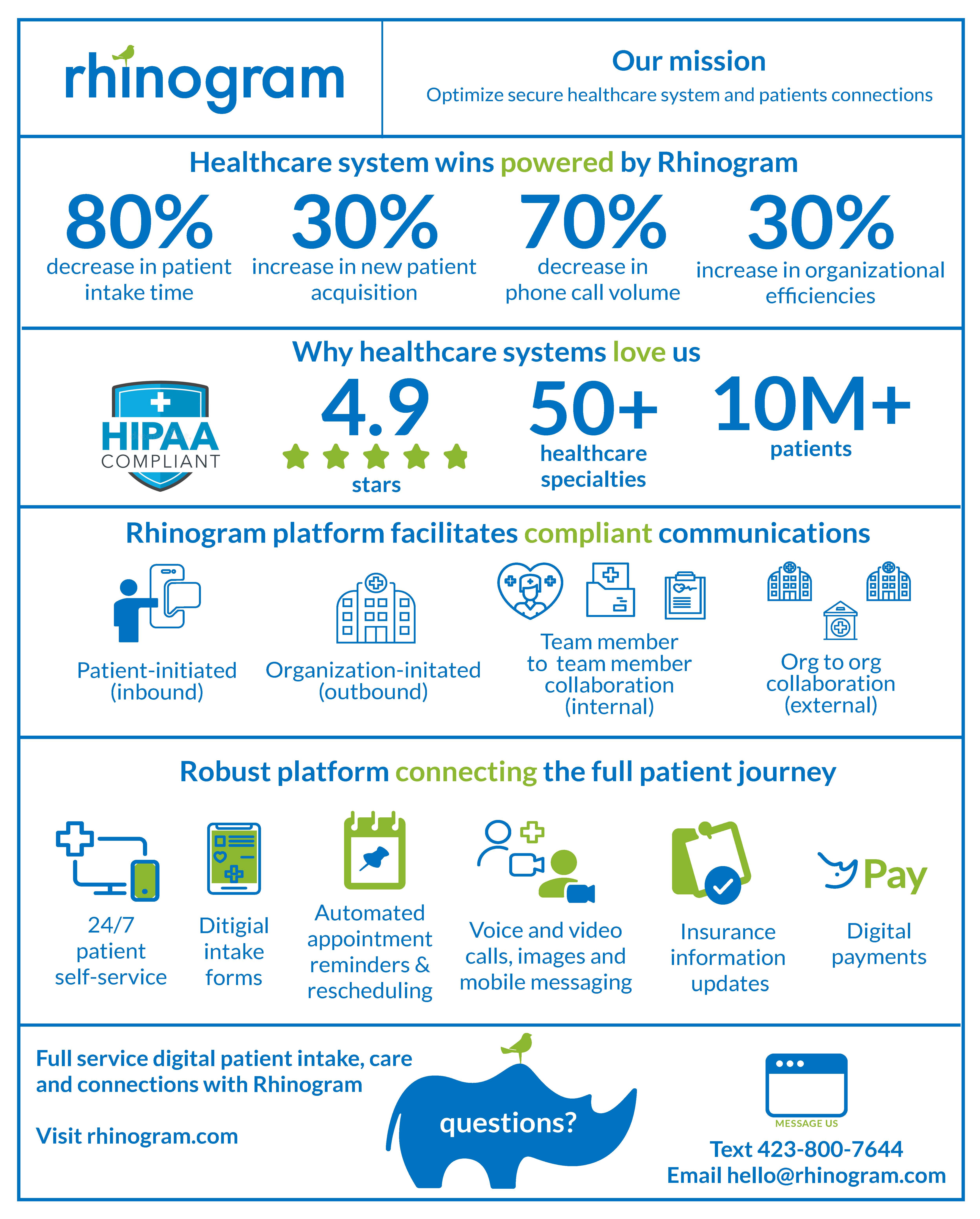
Health care system wins powered by rhinogram:

  • 80% reduction in intake time
  • Up to 30% increase in net new patient acquisition
  • 70% decrease in phone call volume
  • Up to 30% increase in administrative efficiency
  • Call Center increased productivity, reduced operating costs, and reduced agent churn

Our Healthcare Systems and Patients Love Rhinogram:

  • HIPAA Compliant mobile messaging
  • 4.9 stars in Capterra, G2, and apple app store
  • Serving over 50+ healthcare specialties
  • 14M+ patient users

Rhinogram platform facilitates secure communications across the entire care spectrum:

  • Patient-initiated (inbound)
  • Organization-initiated (outbound)
  • Team member to team member (internal)
  • Organization to organization (external)

Digitally connects the full patient journey in one robust platform:

  • 24/7 patient self-service for appointment scheduling, profile updates, lab results, etc.
  • Digital Patient Intake forms and supported workflows
  • Automated appointment reminders, no-show re-engagement, and rescheduling
  • Secure calls, video calls, telehealth, and photos
  • Insurance, medication management, and records access
  • Digital payments through RhinoPay, compliant with apple pay and google pay.

Compatibility level

Select which hospital or health system you work at and see a personalized compatibility level.

Clients

Select which hospital or health system you work at and see the client list

Use Cases

Description:

Ringo strengthens and modernizes Managed Service Provider (MSP) programs by delivering a vendor-neutral, AI-powered platform that enhances transparency, financial oversight, and workforce performance. Healthcare organizations maintain strategic control of outsourced staffing programs while gaining real-time visibility into spend, vendor accountability, and operational efficiency.

By centralizing MSP workflows into a single system of record, Ringo eliminates fragmented processes, reduces administrative burden, and improves compliance across facilities and departments.

Key MSP Use Cases

  • Enterprise-Wide MSP Visibility: Consolidate all MSP activity across hospitals, clinics, and service lines into a single dashboard, delivering real-time insight into labor spend, open requisitions, fill rates, and vendor performance.
  • Vendor-Neutral Oversight: Ensure equitable job distribution, eliminate vendor bias, and maintain full transparency across primary MSP and secondary staffing suppliers.
  • Requisition & Workflow Standardization: Streamline intake, approval, and job posting workflows across departments to reduce time-to-fill and improve operational consistency.
  • Rate Card Governance & Cost Control: Enforce approved rate structures, automate exception approvals, and leverage benchmarking analytics to prevent cost overruns and identify savings opportunities.
  • Timekeeping & Invoice Validation: Automate timecard submissions and approvals, cross-reference invoices against contract terms, and reduce billing discrepancies and overpayments.
  • Performance & SLA Monitoring: Track vendor and MSP performance against SLAs, fill rates, response times, and compliance standards to strengthen accountability and improve outcomes.
  • Compliance & Credentialing Assurance: Centralize licensure and certification tracking, automate expiration alerts, and maintain audit-ready documentation to reduce regulatory risk.
  • Hybrid Staffing Model Support: Manage MSP programs alongside direct vendor relationships and internal float pools to support flexible, blended workforce strategies.
  • Financial Forecasting & Workforce Planning: Analyze historical labor utilization to predict demand, reduce overtime reliance, and align staffing strategies with budget and margin objectives.
  • Executive-Level Reporting: Deliver board-ready reporting and actionable insights to CFOs and COOs on labor trends, vendor performance, and measurable workforce ROI.
Pediatric use cases:

None provided

Users:
  • Site Directors & Operations Managers: Monitor MSP performance, open requisitions, fill rates, and labor spend across facilities through centralized dashboards that improve operational control and workforce efficiency.
  • Managed Service Provider (MSP) Leaders: Standardize requisition workflows, enforce rate cards, track SLAs, and ensure consistent processes across all facilities while maintaining transparency and accountability.
  • Staffing Firms & Vendor Partners: Receive and respond to requisitions in real time, manage submissions, track performance metrics, and ensure compliance within a vendor-neutral, transparent ecosystem.
  • Hiring Managers & Department Leads: Submit and approve requisitions through streamlined workflows, gain visibility into candidate pipelines, and ensure timely department coverage with qualified clinicians.
  • Finance & Accounts Payable Teams: Consolidate invoices across all MSP and vendor partners, automate invoice validation against timecards and rate cards, and maintain audit-ready financial documentation.
  • Chief Operating Officers (COOs): Gain enterprise-wide oversight of outsourced staffing programs, improve vendor accountability, reduce premium labor spend, and align workforce strategy with operational goals.
  • Human Resources & Workforce Leaders: Track credentialing compliance, onboarding status, and vendor performance while ensuring consistent workforce policies across departments and locations.
  • Information Technology (IT) Directors: Integrate Ringo’s MSP platform with HRIS, payroll, ERP, and scheduling systems while maintaining data integrity, security, and interoperability.
  • Chief Financial Officers (CFOs): Enforce rate governance, monitor contract labor trends, forecast workforce spend, and optimize MSP partnerships to protect margins and improve financial predictability.
  • Supply Chain & Procurement Leaders: Standardize vendor contracting, evaluate supplier performance, and drive cost containment strategies across the MSP program.
  • Compliance & Risk Officers: Monitor credential expirations, enforce regulatory standards, automate audit trails, and reduce exposure to billing or workforce compliance risks.
  • Medical Group & Service Line Administrators: Coordinate staffing across specialties and locations while ensuring SLA adherence, cost control, and consistent clinician quality.
Description:

Bee Well Pediatrics in El Paso Texas continually seeks to innovate and integrate in order to provide access and continuity of care. Bee Well Pediatrics implemented Rhinogram for its ability to reach and engage patients even at a distance, while also integrating into existing workflows and processes, and auto-populating the electronic health record systems to optimize and integrate with existing workflows. 

When a child gets sick or has an accident, time is of the essence. Parents want to get their children seen by a doctor without having to wait weeks for an appointment or miss an afternoon of work or school because of long wait times. 

In a study of 21 million outpatient visits, researchers found that more than one-fifth of doctor’s visits had wait times longer than 20 minutes and Medicaid patients were more likely to wait even longer. In El Paso, patients face the longest wait times in the country–just under 27 minutes. Across the nation in major and mid-sized metropolitan areas, scheduling a new patient appointment takes an average of 24 days to be seen.

For Bee Well El Paso Pediatrics, integrating Rhinogram means treatment can be provided to patients wherever they may be leading to better care and better patient experience.

Pediatric use cases:

The average a patient spends in a pediatric office is more than 2 hours for a 15-minute appointment. Pediatric systems like Bee Well can better cater to the needs of busy parents and caregivers with Rhinogram and reduce wait times through virtual care options for busy patients and those who do not need to be seen in person. Parents can interact with pediatric systems safely and securely to complete every task across the patient journey digitally: 

  • Initiate an SMS/MMS text message to the Pediatric system's main phone number to ask questions and initiate a new patient appointment without having to make a phone call. 
  • Receive, complete, and digital intake forms automatically from the system via SMS/MMS text link and can complete intake forms on their mobile device with as little as one bar of cell service, and without having to take the added step of logging into a portal, download an app, print out forms or complete them by hand. 
  • Receive appointment reminders and utilize self-service rescheduling.
  • Check in remotely, remain safely within a virtual waiting room, and receive instructions to go to their exam room on the day of the appointment. 
  • Message real-time with the administrative and care team and participate in virtual video care interactions vs in-person. 
  • Receive and reference aftercare instructions, initiate a text with follow-up questions, and follow-up appointments, receive ongoing education and campaign blasts, and complete payments via RhinoPay. 
Users:

Pediatric system, medical facilities, clinical care, and administrative team members, patients, authorized family members, caregivers, and 3rd-parties.  

EHR Integrations

Integrations:

ERP system, Credentialing, Website / public online sources, Other

EMR Integration & Relevant Hardware:

Not offered

EMRs Supported:

Not applicable

Hardware Compatibility:

Desktop, Mobile / Tablet (web optimized)

Integrations:

Acute care EMR, Ambulatory EMR, Ancillary EMR, Home health, Behavioral health, Community based organizations, ADT, Access +/or revenue cycle, Website / public online sources, Other

EMR Integration & Relevant Hardware:

Recommended, but not required

EMRs Supported:

Epic, Cerner, Meditech, Allscripts, NextGen, athena, GE, eClinicalWorks, McKesson, Allscripts/Eclipsys, Other, Athenahealth, Azalea Health/Prognosis, CPSI, Evident, Healthland, MEDHOST, MedWorx, QuadraMed, Self-developed

Hardware Compatibility:

Desktop, Mobile / Tablet (web optimized), Mobile / Tablet (native app), Other

Client Types

Awards

edit-media
edit-media
edit-media
edit-media

Differentiators

Differentiators vs EHR Functionality:
  • Workforce & Vendor Management Focus: Purpose-built for contract labor, MSP governance, and vendor oversight vs. EHR systems designed primarily for clinical documentation and patient care.
  • Internal Resource Pool Management: Built-in internal float pool prioritization and agency comparison vs. limited contingent labor visibility or workaround scheduling tools in EHR platforms.
  • Credentialing & Compliance Automation: Fully integrated license, certification, and vendor compliance tracking with automated alerts vs. siloed HR modules or manual spreadsheet tracking within EHR environments.
  • End-to-End Contingent Workforce Workflow: True lifecycle coverage from requisition to invoicing and performance analytics vs. fragmented handoffs between EHR, HRIS, and finance systems.
  • Rate Card Governance & Enforcement: Centralized, enforceable rate cards with automated exception workflows vs. manual approvals or vendor-controlled pricing structures.
  • Vendor-Neutral Distribution: Fair and automated job distribution across approved vendors vs. limited or biased vendor routing mechanisms.
  • Invoice Validation & Audit Controls: Automated timecard-to-invoice matching and contract validation vs. manual reconciliation in ERP or finance modules.
  • Real-Time MSP Performance Analytics: Live dashboards tracking fill rates, SLAs, spend, and vendor performance vs. static reports not designed for staffing optimization.
  • Financial Transparency for Contract Labor: Dedicated contingent labor tracking and forecasting vs. bundled labor costs within broader payroll or HR reporting in EHR systems.
  • Hybrid Workforce Support: Supports MSP, direct vendors, and internal staff in one unified platform vs. EHR systems that focus primarily on employed workforce scheduling.
Differentiators vs Competitors:
  • Vendor-Neutral Governance: True vendor-neutral platform with transparent job distribution and performance tracking vs. MSPs that prioritize preferred vendors or internal markups.
  • Technology-First, Not Service-First: AI-powered platform designed to give healthcare systems control and visibility vs. traditional MSPs that rely heavily on manual processes and service-layer dependency.
  • Full Financial Transparency: Centralized rate card enforcement, automated invoice validation, and real-time spend dashboards vs. opaque fee structures and limited cost visibility.
  • Enterprise-Wide Visibility: Single system of record across hospitals, clinics, and service lines vs. fragmented reporting across facilities or regions.
  • Hybrid Workforce Flexibility: Supports MSP programs, direct vendor relationships, and internal float pools simultaneously vs. competitors that lock clients into rigid, single-channel staffing models.
  • AI-Driven Forecasting & Optimization: Predictive analytics to reduce overtime and improve fill rates vs. reactive staffing models based on historical reporting only.
  • Automated Compliance & Credentialing: Integrated license tracking, expiration alerts, and audit-ready documentation vs. manual compliance oversight or disconnected credentialing systems.
  • Real-Time Performance Accountability: Live SLA tracking, fill-rate monitoring, and vendor scorecards vs. static quarterly reviews or delayed reporting cycles.
  • Integrated Timekeeping & Invoice Audits: Automated timecard validation against contract terms to prevent overbilling vs. manual reconciliation and error-prone finance workflows.
  • Scalable Enterprise Integrations: Open APIs connecting to ERP, HRIS, payroll, and scheduling systems vs. limited or costly custom integrations.
  • Executive-Level Reporting & ROI Tracking: Board-ready analytics demonstrating labor savings, vendor performance, and workforce efficiency vs. operational reports lacking strategic insight.
  • Client-Controlled Strategy: Healthcare organizations retain strategic control over vendors, rate governance, and staffing decisions vs. competitors where the MSP drives decision-making.
Differentiators vs EHR Functionality:
  • Patients and healthcare systems alike can initiate an SMS/MMS text message safely and securely without patients having to log in to a portal or log into an app 
  • Integrated natural language conversion 
  • Easily and HIPAA-compliantly communicate with new and existing patients the way they want to communicate
  • No broadband is required, patients can text message the system's main phone number, receive messages, complete and sign intake forms, send photos, participate in video calls, receive aftercare messages, and pay their bills without ever having to log in to a platform or app. 
  • Utilize workflows, automation, AI, and integration with EHR systems to optimize processes and provide the best care as efficiently and conveniently as possible. 
Differentiators vs Competitors:
  • SMS/MMS bi-directional communication with both patients and every member of the care and administrative team across the entire patient journey  
  • Fully integrated HIPPA-compliant, secure messaging and content management 
  • Team chat, full visibility, and @ mentions for staff task assignments 
  • EHR Integration with auto-populate feature 
  • AI and smart message routing and workflow automation  
  • Implementation and efficiency  

Keywords

Images

1 of 12

edit-media
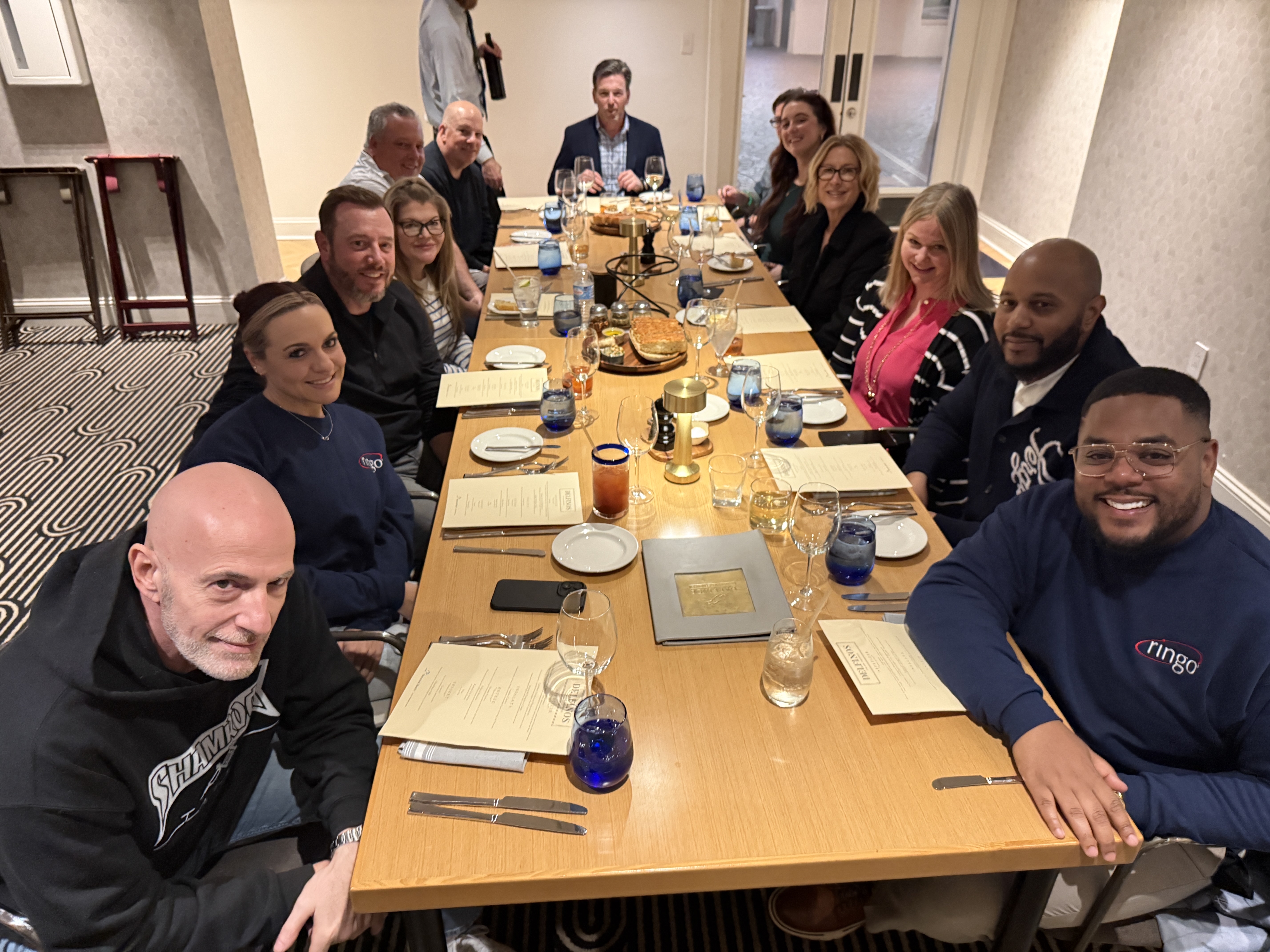
Team Offsite Dinner

1 of 5

edit-media
rhinogram infographic.jpg

Videos

1 of 3

Client Admin Video.mp4

1 of 2

edit-media

Downloads

media thumbnail
Ringo Managed Service Provider (MSP) Overview
media thumbnail
rhinogram infographic.jpg

Alternatives

Company Details

Founded in 2015

team illustration
Share your product comparison with your collegues.

Need help narrowing down products?

Add more criteria to see your compatibility level for every vendor. It only takes a few minutes, just create a free account to get started.
back to top